Virgin Atlantic Reward Credit Cards Explained
If you collect Virgin Points casually, your balance tends to grow in fragments — a flight here, a transfer there, some shopping portal activity. Over time the total becomes meaningful, but progress can feel slow.
The Virgin Atlantic credit cards change that dynamic. They turn routine household spending — groceries, bills, subscriptions, online shopping — into structured progress inside Flying Club. More importantly, they introduce an annual reward voucher that compresses the distance to a premium booking.
This matters because Virgin Points are strongest when used for long-haul Premium or Upper Class redemptions. Those cabins require meaningful balances. Without a steady earning engine, redemptions drift into “eventually.” With a card and a predictable voucher trigger, they become plannable inside 12 months.
It is not “which card earns more points?” It is “can this card realistically move me into Premium or Upper within a year?” Once you frame it that way, the difference between the free card and Reward+ becomes much clearer.
The Two Cards Compared
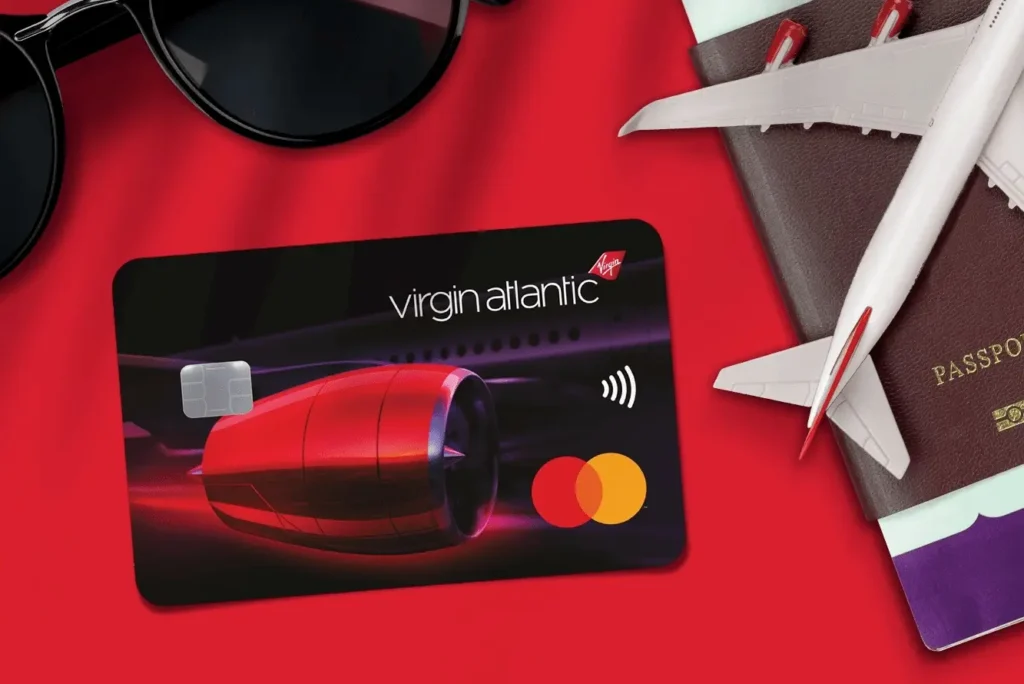
Virgin Atlantic has two UK credit cards, both issued by Virgin Money as Mastercards. Both earn Virgin Points directly into Flying Club and both can trigger an annual reward voucher. But they behave differently depending on how much you spend.
| Reward (Free) | Reward+ (£160/yr) | |
|---|---|---|
| Everyday earn rate | 0.75 VP per £1 | 1.5 VP per £1 |
| Virgin Atlantic / Holidays | 1.5 VP per £1 (double) | 3 VP per £1 (double) |
| Sign-up bonus | 3,000 VP (first purchase) | 18,000 VP (first purchase) |
| Annual fee | £0 | £160 |
| Representative APR | 26.9% variable | 69.7% variable (inc. fee); 26.9% on purchases |
| Voucher threshold | £20,000 annual spend | £10,000 annual spend |
| Voucher type | Companion or upgrade | Companion or upgrade |
| Voucher validity | 2 years | 2 years |
| FX fees | 0% EEA (€/SEK/RON), 2.99% elsewhere | 0% EEA (€/SEK/RON), 2.99% elsewhere |
| Monthly earn cap | Equal to credit limit | Equal to credit limit |
| Can hold both? | Yes — Virgin Money allows both simultaneously, each with its own sign-up bonus and voucher | |
Both vouchers are identical once earned — the same value, same rules, same two-year validity. The only difference is how much you spend to trigger them.
How the Earning Works in Practice
Everyday spending
Groceries, bills, subscriptions, and shopping earn 0.75 points per £1 on the free card and 1.5 points per £1 on Reward+. The difference between 0.75 and 1.5 compounds quickly. On £1,000 of monthly household spend, the free card generates 9,000 Virgin Points per year. Reward+ generates 18,000 — a full Economy return to New York at Saver rates.
Virgin travel spend
Flights booked directly with Virgin Atlantic and Virgin Holidays packages earn double: 1.5 VP per £1 on the free card, 3 VP per £1 on Reward+. This makes the card particularly strong for paying the taxes and charges on reward bookings, or booking cash fares where you want to maximise earning.
Sign-up bonuses
Both bonuses post after your first purchase — no minimum spend target required. The Reward+ bonus of 18,000 points is triggered by any transaction, however small. That bonus alone more than covers the £160 annual fee at any reasonable valuation of Virgin Points.
The credit limit cap
Monthly points earning is capped at your credit limit, even if you pay down your balance mid-month and spend again. If your credit limit is £5,000, you earn points on the first £5,000 of spend that month and nothing beyond. Bonus points from Virgin Atlantic or Holidays spend are excluded from the cap.
This only matters for high spenders who cycle their balance. For most cardholders, the cap is irrelevant.
The Voucher — Where the Real Leverage Sits
Both cards trigger the same reward voucher when you hit the annual spend threshold. It is issued immediately once the target is reached and is valid for two years. Full voucher strategy — including caps, the upgrade loophole, status restrictions, and worked examples — is covered in the dedicated voucher guide. Here is what you need to know for choosing between the cards:
The voucher can be used as a companion ticket (a second person flies on the same booking) or as an upgrade (you move up one cabin on your own ticket). It works on cash bookings and points bookings.
The voucher has a maximum value that depends on your Flying Club status at the time you redeem:
| Status | Max voucher value |
|---|---|
| Red (entry level) | 75,000 VP |
| Silver | 150,000 VP |
| Gold | 150,000 VP |
If the seat costs more than the voucher cap, you pay the difference from your own points balance. If it costs less, the remainder is lost — the voucher is use-it-or-lose-it with no residual value.
Your status at the time you redeem determines the cap, not your status when you earned it. If you earn the voucher as a Red member but later reach Silver, the voucher upgrades to 150,000 VP.
Red tier members can only use the companion voucher in Economy or Premium Economy. Silver and Gold members can use it in Upper Class. If you want a companion in Upper, you need Silver or Gold status — or you use the voucher as an upgrade instead.
Switching Between the Cards
Most travel credit card issuers make moving between a free card and a paid card unnecessarily difficult. Virgin Money is no exception to this general pattern — but it has introduced two distinct routes that are worth understanding before you decide which card to apply for first.
Route A: Hold both cards simultaneously
Virgin Money now permits cardholders to hold both the free Reward Mastercard and the paid Reward+ Mastercard at the same time. If you already hold the free card, you can simply apply for Reward+ and receive a 18,000 Virgin Points bonus on first purchase. The reverse also applies: Reward+ holders can apply for the free card and receive the 3,000 point bonus on that card too.
Once you have both, cancel whichever you no longer want at your convenience — probably once you have triggered its annual voucher or earned its sign-up bonus. There is no pro-rata refund of the Reward+ fee on cancellation, so timing matters.
The limitation of this route is that any spend accumulated towards the current year’s voucher on your original card does not carry across to the new one. Each card tracks its own progress independently. If you are midway through your membership year and close to the voucher threshold on the original card, completing it there before adding the second card is the logical move.
Your card anniversary date is visible in the Reward Lounge section of the Virgin Money app — useful for tracking progress and timing any switch.
Route B: The online upgrade tool (carries over your spend)
For those who want to change cards without losing progress towards the annual voucher, Virgin Money offers an online upgrade and downgrade tool. This route works differently from a standard product switch and has several mechanics worth knowing before using it.
When upgrading from free to Reward+: the card converts immediately and the full £160 annual fee is charged straight away. The membership year end date does not change — so if you are upgrading mid-year, you will pay the full fee for a portion of a year. However, the earning is backdated: you receive a compensatory bonus equivalent to the difference between what you actually earned on the free card this year (0.75 VP per £1) and what you would have earned at the Reward+ rate (1.5 VP per £1). On £12,000 of spend in the current year, that equates to a 9,000 Virgin Points top-up. Any spend you already accumulated towards the £20,000 free card voucher threshold is carried over and benchmarked against the Reward+ threshold of £10,000 — meaning the voucher can trigger immediately if you have already exceeded £10,000 in the current year.
There is also a time-limited incentive: if you upgrade your free Reward card to Reward+ within 90 days of first applying for it, an additional 15,000 Virgin Points bonus is awarded on top. This is a fixed amount regardless of any current promotional offer on the Reward+ card.
When downgrading from Reward+ to free: the mechanics run in reverse, and almost entirely in the issuer’s favour. There is no pro-rata fee refund, and your earn rate drops immediately to 0.75 VP per £1. The only rational reason to use the downgrade route is a narrow one: if the next year’s annual fee has just been charged and the card has seen no use in the current membership year, a downgrade will trigger a full refund of that fee. Outside that scenario, downgrading mid-year costs you both the fee and the earn rate without any compensation.
Route A (hold both) is better for sign-up bonus hunters and those who have just triggered their current voucher. Route B (upgrade tool) is better for those mid-year who have spent significantly on the free card and want to preserve that progress. The 90-day window for the 15,000 bonus on Route B adds a third consideration if you are within that timeframe.
Foreign Exchange Fees
Both cards charge 0% FX fees on spending in Euros, Swedish Kronor, and Romanian Lei within the European Economic Area. This is genuinely useful for European holidays and city breaks — you save 2.99% compared to a standard credit card and still earn Virgin Points on top.
For spending in all other currencies (USD, GBP equivalent overseas, etc.), the standard 2.99% FX fee applies. For non-Euro overseas spend, Capital on Tap’s 0% global FX fee is the better option if you have a limited company.
The Strategies
Strategy 1: Reward+ first, then decide
Apply for Reward+. Collect the 18,000 bonus after your first purchase. Earn at 1.5 VP per £1 on everything. Hit the £10,000 voucher threshold. After year one, decide whether the £160 fee is worth continuing or downgrade to the free card.
Year one maths on £10,000 spend: 18,000 sign-up bonus + 15,000 earned (10,000 × 1.5) + voucher = 33,000 Virgin Points plus a voucher worth up to 75,000–150,000 VP. That is 33,000 points and a voucher for £160. Outstanding value.
Strategy 2: Hold both cards
Virgin Money allows both the free Reward card and the paid Reward+ simultaneously. Each card earns its own sign-up bonus and triggers its own voucher at its own threshold. A household putting £10,000 through Reward+ and £20,000 through the free card earns two vouchers per year — powerful for a family of four where two companion tickets cover everyone.
Strategy 3: Free card only
If your spending naturally reaches £20,000 per year (roughly £1,670/month), the free Reward card delivers the same voucher for zero cost. At 0.75 VP per £1, you earn 15,000 Virgin Points plus the voucher. No fee, no risk, no commitment beyond spending you were making anyway.
Strategy 4: Pair with Amex
Use Amex Gold or Platinum as your primary earn card (1 MR per £1, flexible, transferable 1:1 to Virgin). Use the Virgin Mastercard for retailers that do not accept Amex and to hit the voucher threshold. This gives you flexibility (Amex MR stays flexible until you need it) plus the voucher (which requires the Virgin card).
Points should never come with debt. Reward credit cards only make sense when balances are paid in full each month. The representative APR on Reward+ is 69.7% variable (including the £160 fee). If you carry a balance, interest charges will wipe out any realistic redemption value within weeks. Treat the card as a routing tool, not a borrowing tool.
Stacking with Shops Away
The Virgin Mastercard stacks with the Shops Away portal. A single online purchase can earn portal points (typically 3–20 VP per £1 depending on retailer) plus card points (0.75 or 1.5 VP per £1). A retailer offering 8 VP per £1 on the portal, paid with Reward+, delivers an effective 9.5 VP per £1 from a single transaction. At 1p per point, that is a 9.5% rebate on a purchase you were making anyway.
This stacking is the single highest-return earning behaviour available to UK Virgin Points collectors. Making it habitual — portal first, then card — is worth more over a year than any individual bonus or promotion.
Who Should Get Which Card
Get Reward+ if: you can realistically spend £10,000/year on the card, you want the faster voucher trigger, and you value 1.5 VP per £1 over 0.75. The maths works in year one with the sign-up bonus alone.
Get the free Reward card if: your spending is lower or inconsistent, you are still learning how Flying Club works, or you want the voucher without committing to a fee. The £20,000 threshold is harder to hit, but the voucher is identical once earned.
Get both if: your household spend supports two vouchers. Two adults, each with a card, each hitting their threshold, each earning a voucher — that covers a family of four with two companion tickets on the same flight.
The card is not primarily about the sign-up bonus or the earn rate. It is about the voucher. Points accumulate gradually; the voucher compresses the distance to a premium booking. Choose the card that lets you trigger the voucher reliably — and then use it deliberately.