
Your Work Trips Are Funding Better Holidays
If you travel for business — even occasionally — you’re probably accumulating hotel points, airline miles and credit card spend without thinking much about it. Midweek stays in chain hotels. Flights booked for convenience. Card spending that earns points on autopilot.
Most people let this value scatter. A few thousand points here, a half-built status tier there. Nothing quite reaches the level where it changes anything meaningful.
The shift happens when you start treating work travel as an earning engine and personal travel as the moment where that earning gets spent. Not on every trip. Not on small conveniences. On a small number of high-impact personal journeys each year where points, status and vouchers genuinely change how the trip feels.
The objective isn’t to use points frequently. It’s to use them deliberately — on the one or two personal trips a year where they make the difference between a standard holiday and something noticeably better. Pick those trips, protect your balance for them, and let the work travel keep feeding the system.
Part I: Hotel Points as Your Personal Travel Engine
Hotel status is one of the few work benefits that transfers cleanly into personal life. The Hilton Gold you earned from 40 midweek nights applies identically to a week-long family holiday at a Conrad resort. The Marriott Gold from your Amex Platinum works at a Ritz-Carlton just as well as it does at a Courtyard.
Where these benefits really compound is on longer personal stays. Breakfast included every morning for a family of four across five nights can save £200–400. Late checkout on departure day removes the rush. An occasional room upgrade adds space and comfort without extra cost. None of these feel dramatic on a single night. Across a week, they reshape the experience.
The practical rule: save your hotel points for multi-night personal stays where the benefits repeat and compound. Burning 30,000 Hilton points on a forgettable Tuesday-night airport hotel wastes a balance that could contribute to a proper holiday.
Pick one to three personal trips you actually care about this year. Protect your points and vouchers for those. If you can’t name the trip, don’t spend the balance. The strongest use of work-earned points is always a deliberate personal trip, not a convenience redemption.
Part II: The Step-Up Method
When it comes to flights, the biggest constraint isn’t usually earning enough points. It’s finding Business Class reward seats on the dates you actually want to travel. Full Business Class availability is scarce on peak leisure dates — school holidays, bank holiday weekends, Christmas. Relying on it can make premium travel feel like a lottery.
The step-up method is the reliable alternative. Instead of searching for Business Class availability and hoping, you secure the flight in a lower cabin first — typically Premium Economy — and then apply points or a voucher to move up one class once you’ve confirmed the upgrade pathway exists.
Why this works
It separates two decisions that most people wrongly combine. Decision one: am I flying on these dates? Decision two: can I fly in a better cabin? By booking the lower cabin first, you lock in the dates and the route. Then you investigate whether an upgrade is available. If it is, you step up. If it isn’t, you still have your flight — in a cabin that’s already better than economy.
The sequence matters
1. Choose the route and dates. Identify which leg is “comfort-critical” — usually the overnight sector where sleep matters most.
2. Book the base cabin. Secure Premium Economy (or economy) with an upgrade-eligible fare. Not all fares allow upgrades — the cheapest restricted tickets often block them. Check the fare rules before booking.
3. Verify the upgrade pathway. Confirm that reward availability exists in the cabin above, and that your voucher or points mechanism actually works for your specific fare class and route. Don’t assume — check.
4. Upgrade immediately. Once the pathway is verified, commit. The risk isn’t overpaying — it’s the upgrade inventory disappearing while you deliberate.
Step-up isn’t “second best.” In the UK ecosystem it’s often the primary premium strategy, because it separates schedule security (book the flight) from comfort optimisation (upgrade later). Use it whenever the date matters more than the cabin — which, for most personal travel, is most of the time.
The UK Upgrade Tools
Two specific tools do the heavy lifting for step-up upgrades in the UK:
The Barclays Avios upgrade voucher
This is one of the most valuable and most misunderstood tools in UK travel. Despite the name, it’s not technically an upgrade voucher — it lets you book the higher cabin but pay the Avios price of the cabin below.
In practice: you book a Business Class reward seat on BA and apply the voucher. Instead of paying the Business Class Avios price (say, 88,000 Avios one-way to New York off-peak), you pay the Premium Economy Avios price (around 58,000 Avios). You still pay Business Class taxes and fees in cash. But you save 30,000 Avios on that single leg — and on a return to New York, the voucher saves around 66,000 Avios at peak pricing.
You can earn up to two upgrade vouchers per year: one through Barclays Premier banking with Barclays Avios Rewards (£12/month fee), and one through the Barclaycard Avios Plus credit card (spend £10,000 in a year). Each voucher covers one return flight for one person, or two one-way flights for two people. Vouchers are valid for 24 months and can only be used on BA-operated flights booked as Avios reward flights.
Key restrictions: you can’t upgrade into First Class. You must book at the “most Avios, least cash” pricing option. You need reward availability in the higher cabin (not the lower one). And the voucher must be applied at the point of booking — you can’t add it to an existing reservation.
Virgin Atlantic: Premium to Upper Class
Virgin’s dynamic pricing means the points gap between Premium Economy and Upper Class varies by route and date. When the gap is rational — and it often is on less popular dates — stepping up from Premium to Upper Class using Virgin Points can be excellent value. Premium seats are generally easier to find than Upper Class saver fares, so this approach gives you more control over dates.
The key is timing. Check the points price for both cabins on your target dates. If the gap is reasonable and Upper Class availability exists, commit quickly — saver fares disappear fast.
You don’t need to upgrade every leg. On a return long-haul trip, upgrade the overnight sector (where sleep matters) and fly Premium Economy on the daytime leg. You get most of the benefit at roughly half the upgrade cost.
Part III: Premium Economy as the Control Cabin
Premium Economy sits in a strange spot. It lacks the prestige of Business Class and the simplicity of economy, so people often dismiss it as a compromise. In practice, it can be the most controllable and repeatable way to improve long-haul travel — especially on fixed dates.
What Premium Economy actually gives you
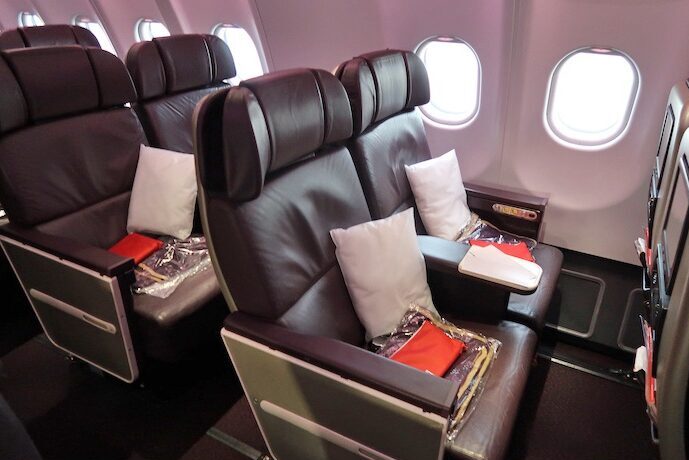
More legroom (typically 38 inches versus 31–32 in economy). A wider seat. A calmer, smaller cabin. Better food and drink. Priority boarding on most airlines. On an overnight flight, the difference between economy and Premium Economy is meaningful — not lie-flat-bed meaningful, but meaningfully more comfortable for sleeping, arriving, and starting your holiday.
Why it works as a strategy
Premium Economy availability is dramatically better than Business Class on popular routes during peak periods. If you’re travelling as a family during school holidays, finding four Business Class reward seats on the same flight is genuinely rare. Finding four Premium Economy seats? Much more achievable.
It also works as a launching pad. Book Premium Economy, then explore whether an upgrade to Business Class is possible using a voucher or points. If it is, step up. If it isn’t, you’re still flying in a comfortable cabin on the dates you need.
Where Premium Economy delivers most value
Overnight sectors where the extra space helps you sleep. London to New York, Singapore, Cape Town — these are the routes where Premium Economy transforms the journey.
Fixed-date travel where Business Class availability is unlikely. School holidays, bank holidays, Christmas — Premium Economy is often the realistic premium option.
Family travel where four seats in the same cabin matters more than one person in Business and three in economy.
Where to skip it
Short daytime flights where the cabin difference is minimal. Routes where Business Class is on sale for a similar price (it happens). Trips where you have no realistic upgrade pathway and the Premium Economy price feels excessive versus economy.
Premium Economy is not a compromise cabin. It’s a control cabin. It locks the schedule while keeping the option open for a later step-up into Business. For fixed-date travel where Business Class availability is uncertain, it’s often the smartest starting point.
Part IV: The Decision Framework
Once you have points, status and vouchers accumulating from work travel, every trip becomes a set of decisions. The goal isn’t perfect optimisation — it’s repeatable choices that consistently improve your trips without requiring hours of research each time.
Cash vs points: Use points when the cash price feels disproportionate. A £4,000 Business Class fare replaced by 88,000 Avios is excellent value. A £70 hotel night replaced by 30,000 points is not.
Hotel vs flight: Prioritise whichever removes the largest cost barrier from the trip you actually want to take. If the hotel is the expensive part, spend points there. If the flights are, focus on those.
Premium Economy vs Business: Choose Business for sleep-critical overnight sectors where the lie-flat bed genuinely changes how you arrive. Choose Premium Economy when dates are fixed, availability is tight, or you’re travelling as a family and need multiple seats together.
Upgrade vs full redemption: Upgrade (using step-up) when Business Class reward seats are scarce and you can confirm the pathway. Book a full Business Class redemption when availability lines up cleanly — it’s simpler and often cheaper in total Avios.
Part V: Common Mistakes That Waste Your Leverage
Most strategies don’t fail because of poor earning. They fail because of scattered decisions that quietly drain value over time.
Programme dilution. Splitting stays across Hilton, Marriott, IHG and Hyatt means slow status progress everywhere and usable balances nowhere. Pick one and concentrate.
Speculative transfers. Moving Amex points into BA without confirmed availability traps your balance. If the seats disappear, you’re stuck with Avios you didn’t need yet. Always confirm availability first, then transfer.
Upgrade chasing without a pathway. Assuming Business Class will “probably be available” and building your trip around that hope. Step-up only works when you verify the pathway exists. Without verification, it’s just wishful thinking.
Convenience redemptions. Using 40,000 points on an airport hotel because you had a late arrival. That’s 40,000 points that won’t be available for a family holiday where they’d save £400+ in breakfast alone. Protect your balance for the trips that matter.
If a redemption doesn’t materially improve the trip, pause. Ask yourself: would I notice the difference between paying cash and using points on this stay? If the answer is no, pay cash, earn points on the stay, and save the balance for something you’ll actually remember.
Part VI: Building Your System
The end state isn’t a collection of tactics. It’s a quiet system that works in the background and improves your travel without constant intervention.
Primary airline pathway: Avios or Virgin Points, based on your routes, availability patterns and which vouchers you can access.
Primary hotel programme: Hilton, Marriott, IHG or Hyatt — whichever your work travel naturally feeds.
Transferable currency layer: Amex Membership Rewards sitting as the flexibility reserve. Points stay here until you’re ready to book, then transfer to whichever programme has the availability you need.
Upgrade mechanism: Barclays upgrade voucher, BA companion voucher, or Virgin step-up — embedded into your annual planning rather than left to chance.
When this system is running, most trips improve quietly. Work travel earns the points and status. Personal trips spend them deliberately. Experience builds confidence. Booking gets faster. The loop compounds year after year.
Work travel creates leverage. Personal travel is where you spend it. Use the step-up method to upgrade flights reliably — book the lower cabin first, verify the upgrade pathway, then commit. Treat Premium Economy as a control cabin, not a compromise. Save points for the trips that matter most. And build a simple, repeatable system: one airline pathway, one hotel programme, transferable points as the safety net, and an upgrade mechanism you understand and plan around.