Booking Mechanics: What’s Actually Happening When You Redeem
Every reward booking has a technical layer beneath it. Understanding how airlines price their inventory — the zone charts, dynamic algorithms, tax structures and partner pricing rules — is what separates people who consistently get excellent value from people who feel like the system is working against them.
This article covers the booking mechanics that apply across the major programmes accessible to UK travellers: BA Avios, Virgin Atlantic Flying Club, Emirates Skywards, Qatar Airways Privilege Club, and the hotel loyalty schemes. It’s deliberately technical — this is the Pro Strategy section, and the detail here is what makes the difference when you’re comparing options, troubleshooting a booking, or working out why two seemingly identical flights cost vastly different amounts in points.
Most frustration with reward bookings comes from not understanding the mechanics. “Why does this flight cost so many points?” and “Why are the taxes so high?” almost always have a technical answer. Once you understand the pricing structure of each programme, the system becomes predictable rather than mysterious.
The Three Pricing Models
Airlines use fundamentally different approaches to pricing reward seats. Understanding which model you’re dealing with changes how you search, when you book, and what you can expect to pay.
Model 1: Fixed zone-based charts
BA groups destinations into zones based on distance from London. Each zone has a set Avios price per cabin class, with separate rates for peak and off-peak dates. The price you pay for a BA reward flight is determined by three things: the distance zone, the cabin, and whether your travel date falls in peak or off-peak.
This is predictable and transparent. A Business Class return to New York costs 176,000 Avios off-peak (88,000 each way) regardless of whether you book 355 days out or 14 days before departure. The Avios price doesn’t change with demand — only availability and the cash component change.
Qatar Airways Privilege Club also uses Avios with a distance-based chart, though its own pricing differs from BA’s. Qatar has introduced peak and off-peak bands: a Qsuites Business Class seat from London to Doha costs roughly 70,000 Avios off-peak, rising to around 94,500 at peak. Iberia and Aer Lingus each have their own Avios charts too — and on overlapping routes, Iberia is often cheaper than BA for the same Avios currency.
The critical point about fixed-chart programmes: you can calculate exactly what a booking will cost before you search. This makes planning straightforward, and it’s why fixed-chart programmes tend to deliver the most predictable value.
Model 2: Dynamic pricing
Virgin Atlantic switched to fully dynamic reward pricing in October 2024. There’s no published chart for Virgin-operated flights. The Virgin Points cost varies with demand, date, and booking window — much like cash fares. An Upper Class seat to New York might cost 29,000 points one-way on a quiet Tuesday in February, but 150,000+ points on a Friday in August. Economy can drop as low as 6,000 points one-way on saver fares.
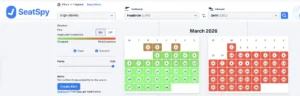
Dynamic pricing rewards flexibility. If you can travel on off-peak dates, Virgin’s saver fares offer exceptional value — some of the lowest premium-cabin redemption rates available from the UK. But if your dates are fixed during peak periods, the points price can escalate to the point where cash might be more efficient. The Reward Seat Checker on Virgin’s website shows a monthly calendar view with pricing — use it to spot the saver fare dates before committing any points.
Virgin still uses fixed award charts for partner airline bookings (Delta, Air France-KLM, and other SkyTeam airlines), so the dynamic element only applies to flights Virgin operates itself.
Model 3: Unpublished distance-based (Emirates)
Emirates Skywards doesn’t publish a standard award chart. Instead, you use the Miles Calculator on emirates.com to price specific routes. The miles required depend on the route, fare class and cabin. As a rough guide: London to Dubai in Economy Saver costs around 38,750 miles one-way; Business Class around 72,500 miles.
Emirates also offers Cash+Miles — a flexible system where you can use any number of Skywards miles to reduce the cash price of a ticket. There’s no fixed conversion rate; it varies by route, date and demand. This means Emirates miles have a dual use: full award bookings at set mile prices, or partial cash reductions on any available seat.
A significant restriction as of May 2025: Emirates First Class award redemptions are now limited to Silver, Gold and Platinum Skywards members. Base-tier members can’t book First Class with miles, even if they have enough.
Before transferring Amex Membership Rewards to any programme, check the pricing through every programme that serves your route. The same London–Dubai flight might cost 88,000 Avios through BA, roughly 70,000 Avios through Qatar (with lower surcharges), or 72,500 Skywards miles through Emirates. The same transferable points, routed through different programmes, produce very different outcomes.
Star Alliance: Singapore KrisFlyer and Turkish Miles&Smiles
The programmes above cover oneworld (BA, Qatar), SkyTeam (Virgin Atlantic) and standalone carriers (Emirates). But Star Alliance — the third major alliance — is also accessible to UK points travellers, primarily through two programmes.
Singapore Airlines KrisFlyer uses a fixed zone-based chart with three award tiers: Saver (best value, limited seats), Advantage (higher cost, more availability) and Access (dynamic pricing, worst value — avoid unless desperate). A Saver Business Class seat from London to Singapore costs roughly 80,000–85,000 KrisFlyer miles one-way (post-November 2025 repricing, which added around 5% across most zones). Suites Class on the A380 — the most aspirational redemption in aviation — is bookable with KrisFlyer miles, though availability is extremely scarce.
For UK travellers, the key detail is the Amex Membership Rewards transfer rate: it’s 3:2 (not 1:1). So 30,000 Amex points become 20,000 KrisFlyer miles. This makes KrisFlyer less efficient than Avios or Virgin Points as a transfer destination, but Singapore Airlines’ product — particularly in Business and Suites — can justify the conversion premium when availability appears. Surcharges on Singapore Airlines award flights are generally low. Schedule opens 355 days before departure.
Turkish Airlines Miles&Smiles uses a region-based fixed chart and covers both Turkish Airlines-operated flights and Star Alliance partner bookings. The programme suffered major devaluations in February 2024 and December 2025, roughly doubling many award prices. London to Istanbul in Business Class now costs around 65,000 miles at promotional (saver) rates. Connecting onward adds further segments at additional cost — the pricing is cumulative per segment on Turkish-operated flights.
Turkish Miles&Smiles is not currently an Amex Membership Rewards transfer partner in the UK. It’s accessible through Capital One and Citi (both primarily US programmes), or by earning miles through flying. The main appeal for UK travellers is access to Star Alliance partners — you can book Lufthansa, SWISS, ANA and other Star Alliance carriers through Miles&Smiles, sometimes at competitive rates. The booking website is notoriously clunky, and fuel surcharges are always passed through, which can add £200+ per direction on long-haul.
Star Alliance programmes are less naturally accessible to UK points collectors than oneworld (Avios) or SkyTeam (Virgin Points). But if you’re holding Amex Membership Rewards and want Singapore Airlines Suites or Business Class, the 3:2 transfer to KrisFlyer is the route in. And if you fly Turkish Airlines regularly for work, Miles&Smiles can deliver solid value on their own metal — just be aware that the programme has devalued aggressively in recent years.
Taxes, Surcharges and the Cash You Actually Pay
The points price is only half the equation. Every reward booking has a cash component — taxes, airport fees and carrier-imposed surcharges. This cash element varies enormously across programmes and is often the factor that makes one redemption significantly better than another.
BA Avios: Reward Flight Saver
Since December 2025, BA uses a “Reward Flight Saver” structure where the cash element is a fixed amount per person, per leg — determined by cabin and route type. Short-haul Economy can be as low as £1 each way. Long-haul Business to North America is roughly £100–125 each way. This replaced the old system where carrier surcharges could add £400–600+ to a long-haul Business return, and makes the total cost far more predictable.
BA also offers an Avios & Money sliding scale at checkout: you can choose more Avios with less cash, or fewer Avios with more cash. For long-haul flights, the “most Avios, least cash” option is usually the best value. For short-haul, compare the options — paying slightly more cash and fewer Avios sometimes delivers better overall efficiency. Note: if you’re using a companion voucher or Barclays upgrade voucher, you must use the standard Avios-only pricing option.
Virgin Atlantic: reduced but still present
Virgin historically charged some of the highest surcharges in the industry — often exceeding £1,000 on premium cabin redemptions. The 2024 dynamic pricing overhaul significantly reduced these fees. Surcharges are now more reasonable, though they remain higher on flights departing the UK (due to Air Passenger Duty) than on flights departing the US. Upper Class returns from the UK to New York typically carry £200–400 in taxes and fees on top of the points cost.
For Virgin partner bookings (Delta, Air France-KLM), surcharges depend on the operating airline. Delta flights generally carry low surcharges. Air France-KLM flights can carry higher fees, particularly on long-haul from European hubs.
Qatar Airways: low but rising
Qatar was long the gold standard for low-surcharge redemptions — sometimes just £30–50 in taxes on a Business Class flight. In September 2024, Qatar shifted from segment-based to distance-based redemption fees, increasing costs on longer routes. A Qsuites booking from London to Doha now carries roughly £100–150 in total fees (redemption fee plus government taxes). Longer itineraries — London to Doha to Sydney, for instance — will be higher.
Still, Qatar’s total cash outlay remains well below BA’s on equivalent distances, and the Qsuites product is widely regarded as the world’s best Business Class. The combination of reasonable Avios pricing, moderate fees and an exceptional cabin makes Qatar one of the strongest redemption options available to UK travellers.
Emirates: the surcharge problem
Emirates Skywards award bookings carry substantial carrier-imposed surcharges — often several hundred pounds per leg on premium cabins. A Business Class return from London to Dubai might require 145,000 Skywards miles plus £600+ in taxes and surcharges. On some routes, fees can exceed £1,000 for a return.
This is the main limitation of Emirates as a reward programme. The product is outstanding, but the cash outlay on redemptions often undermines the value proposition. If you’re comparing Emirates with Qatar for Middle East and beyond destinations, Qatar’s lower surcharges frequently tip the balance — even if the Avios/miles pricing looks similar.
Emirates’ Cash+Miles option partly addresses this by letting you use miles to reduce a cash fare (avoiding the separate surcharge structure), but the conversion rate varies and isn’t always competitive.
Taxes and surcharges can make or break a redemption. Two flights costing the same number of points can differ by £500+ in cash depending on the programme you book through. Always check the total out-of-pocket cost — points plus cash — before committing. The “cheapest in points” option isn’t always the cheapest overall.
Guaranteed Availability and How Seats Are Released
Understanding how and when airlines release reward seats is fundamental to booking mechanics. Each programme handles this differently.
BA Avios
BA guarantees minimum reward seats on every long-haul flight from Heathrow and Gatwick: 8 in Economy, 2 in Premium Economy, 4 in Business Class. First Class has no guaranteed allocation — it’s entirely discretionary. These seats release at 355 days before departure and sell first-come, first-served. BA can (and does) release additional seats beyond these minimums, particularly on flights that aren’t selling well in cash. The companion voucher from the BA Amex also unlocks enhanced Business Class availability beyond the standard allocation.
Virgin Atlantic
Under dynamic pricing, Virgin made every seat on every flight bookable with points — there’s no separate “reward inventory.” The catch is that popular flights on popular dates will be priced at astronomical points levels (150,000+ for Economy, 350,000+ for Upper Class). Saver fares — marked with a red tag in the Reward Seat Checker — offer the real value, but there’s no guaranteed number of saver seats per flight. Virgin’s schedule opens roughly 331 days before departure.
Qatar Airways
Qatar releases award seats 355 days in advance. Availability is generally good in Business Class (Qsuites), particularly for Avios programme members — Qatar now makes most premium award space available exclusively to those booking through Avios currencies (Privilege Club, BA Executive Club) rather than through partner programmes like AAdvantage. Saver and Flexi award levels exist: Saver is the better value; Flexi costs roughly double but offers more availability.
Emirates
Emirates releases Classic Reward seats on its own schedule, with availability varying significantly by route and season. Premium Economy was added to the redemption programme in September 2025. First Class redemptions now require Silver status or above. Emirates generally offers decent award availability on its core routes, but premium cabin seats on popular dates (particularly during Dubai high season) can be scarce.
If you’re searching for Qatar Qsuites, book through a programme that uses Avios — either Qatar Privilege Club directly or BA Executive Club. Qatar has increasingly restricted premium cabin availability for partner programmes like American AAdvantage. The Avios route gives you the best chance of finding seats.
Cancellation and Change Rules
Understanding cancellation and change policies is part of booking mechanics — and it’s what enables the “book first, optimise later” approach that experienced travellers use.
BA Avios
£35 per person to cancel (up to 24 hours before departure). Avios refunded, cash taxes refunded to original payment method. Date and time changes within the same route, cabin and peak/off-peak band: £35 per person, no additional Avios. Changes to different peak/off-peak bands require paying the Avios difference. This flexibility is valuable — book as soon as availability appears, then adjust if better dates surface.
Virgin Atlantic
Cancellation fee of approximately £80–100 per person (doubled from the previous £50 when dynamic pricing launched). Points and taxes refunded minus the fee. Changes to award bookings are possible but any cabin re-pricing is dynamic, so the cost of the new flight may differ significantly from the original. Virgin’s higher cancellation fees make speculative booking more expensive than on BA — only book when you’re fairly confident of your plans.
Qatar Airways
Cancellation fees of approximately $25 per ticket if cancelled more than 24 hours before departure. For flights departing the US, the DOT 24-hour free cancellation rule applies. Fees increase for last-minute changes. Relatively low-cost compared to other programmes, making Qatar bookings reasonably flexible.
Emirates Skywards
Classic Reward cancellations and changes carry fees that vary by route and booking type. Generally moderate — less punitive than Virgin’s but not as transparent as BA’s flat £35 fee. Check the specific terms when booking, as they can vary.
Hotel programmes
Most hotel programmes offer free cancellation on award bookings 24–48 hours before check-in. Hilton, Marriott and Hyatt all follow this pattern. Points are refunded to your account. This makes hotel award bookings extremely low-risk — book speculatively and cancel if plans change.
Hotel Reward Pricing
Hotel programmes each use different pricing mechanics, and understanding them helps you identify where points deliver the most value.
Hilton Honors: Fully dynamic pricing — the points cost per night varies with demand and cash rates. Hilton has removed its published award chart entirely. In 2025 alone, the cap on standard award nights rose three times: from 150,000 to 200,000 to 250,000 points per night at the most expensive properties. Mid-range properties typically cost 30,000–80,000 points; luxury resorts can comfortably sit at 150,000–250,000. These rates change without notice. Hilton’s best mechanic is the fifth-night-free benefit: book five consecutive nights on points and the fifth is free, effectively saving 20% on longer stays. That benefit is what makes Hilton redemptions competitive at the luxury end — a five-night stay at 200,000 points per night costs 800,000 rather than 1,000,000.
Marriott Bonvoy: Also dynamic, though Marriott still maintains hidden internal categories (roughly 1–9). The published award chart was discontinued in 2022, and pricing now fluctuates based on demand, season and room type. A mid-tier property might cost 25,000–60,000 points per night. Luxury properties have seen dramatic inflation: top-end resorts can now exceed 200,000 points per night, with some ultra-luxury properties (like the Ritz-Carlton Masai Mara) reaching 325,000–370,000 points. Marriott also offers fifth-night-free (Stay 5, Pay 4) on award stays, which significantly softens the blow at the luxury end.
World of Hyatt: The most straightforward system — fixed points per night based on property category (1–8), with no dynamic variation within the category. A Category 1 is 5,000 points/night; a Category 4 is 15,000; top-end Category 8 (Park Hyatt, Alila) is 30,000–40,000 points/night. This predictability makes Hyatt points among the most consistently valuable in hotel loyalty — you always know what a stay will cost, and the ceiling is dramatically lower than Hilton or Marriott’s current pricing.
The fifth-night-free benefit at Hilton and Marriott is one of the most overlooked mechanics in hotel loyalty. On a five-night stay at a luxury property, it saves the equivalent of 20% of the total points cost. Always book in five-night blocks when possible — and if you’re staying six nights, book five on points (getting one free) and pay cash for the sixth.
Why the Same Journey Costs Different Amounts
One of the most confusing aspects of booking mechanics is discovering that the same journey can cost wildly different amounts depending on how you book it. This isn’t a glitch — it’s the system working as designed across programmes with different pricing structures.
Different programmes, same route: London to New York might cost 88,000 Avios one-way through BA, 29,000–50,000 Virgin Points on a saver fare, or a comparable number of points through Emirates (with much higher surcharges). The “best” option depends on what’s available, what the total cash outlay is, and which programme’s points you have or can transfer.
Same currency, different airlines: Avios can book BA, Qatar, Iberia, Aer Lingus, Finnair and any oneworld partner. Each has its own pricing and surcharges. London to Madrid might be cheaper in Avios on Iberia than on BA. London to the Middle East is almost certainly cheaper through Qatar’s chart than through BA’s partner chart. Always compare across airlines within the Avios ecosystem.
Different booking sites: An Iberia flight booked on iberia.com may cost fewer Avios and lower taxes than the same flight booked on ba.com. An Aer Lingus flight from Dublin avoids UK Air Passenger Duty entirely. Always check the operating airline’s own website.
Peak vs off-peak mechanics: On BA, the difference is fixed and published (roughly 10,000 Avios per leg in Business for long-haul). On Virgin, dynamic pricing means consecutive days can vary by 50,000+ points. On Qatar, the gap between Saver and Flexi awards can be 100% of the base price.
Voucher vs standard: The BA companion voucher halves the Avios cost and can unlock additional Business Class seats. Always search with and without the voucher to see the full picture.
There is rarely one “right” price for a reward booking. The same London to New York journey might cost 88,000 Avios on BA, 29,000 Virgin Points on a saver fare, or 70,000 Avios on Qatar via Doha with minimal surcharges. The booking mechanics reward people who compare across programmes, check multiple booking sites, and understand why prices differ. Five minutes of comparison can save tens of thousands of points.
First Class: The Pricing Anomalies
First Class sits at the top of the reward pricing structure, and each programme treats it very differently.
BA Avios: One of the least-known quirks — on certain routes, First Class costs fewer Avios than Business Class under Reward Flight Saver pricing. London to Abu Dhabi and London to New York have both shown First at 68,000 Avios one-way versus Business at 88,000. Availability in First is never guaranteed (and scarce), but when it appears, check the price — you might be paying fewer points for a better cabin. Combined with a companion voucher, this produces extraordinary value.
Emirates: The most famous First Class product in aviation — onboard showers, suites, caviar — but redemptions are now restricted to Silver tier members and above. Miles costs are high and surcharges are substantial. The Skywards+ subscription (from $399/year) offers 20% discounts on award bookings, which can significantly improve the economics if you’re booking multiple legs.
Qatar: First Class on Qatar’s A380 (limited routes) is bookable with Avios. Pricing is competitive and surcharges are moderate. However, Qatar is phasing out its A380 fleet in favour of the A350, which doesn’t have a First Class cabin — making Qsuites (Business Class) the top product on most routes.
Singapore Airlines: Suites Class on the A380 is widely considered the single best First Class product in the world — double beds, closing doors, exceptional service. Bookable with KrisFlyer miles at Saver rates, but availability is vanishingly rare and only released to KrisFlyer members (not partner programmes). If you spot a Saver Suites seat, book immediately — they disappear within minutes.
Virgin Atlantic: Virgin Atlantic doesn’t have a traditional First Class, but its Retreat Suite (on the A330-900neo) offers a more exclusive space within Upper Class — bookable through the same dynamic pricing at the Upper Class rate.
Booking mechanics are the technical layer that determines what you actually pay for a reward booking. BA uses fixed zone-based Avios pricing — predictable and transparent. Virgin uses dynamic pricing — flexible but variable, with saver fares offering exceptional value to flexible travellers. Qatar uses Avios with its own chart, low-to-moderate surcharges, and one of the best Business Class products in the world. Emirates offers a premium product but carries the highest surcharges. Always compare across programmes and booking sites before committing your points. Understand the cancellation rules that enable speculative booking. And look for the pricing anomalies — First below Business on BA, saver fares on Virgin, Qatar through Avios rather than partner programmes — that turn good redemptions into exceptional ones.