

High-Value Redemptions: How They Actually Work
Airlines run two pricing systems side by side. One is dynamic — cash fares that shift in real time based on demand, competition and proximity to departure. The other is structured — loyalty pricing that moves slowly, if it moves at all. When demand pushes cash fares up, the loyalty price frequently stays put.
That divergence is where high-value redemptions come from. Not from tricks, not from hidden deals — from a structural lag between two systems that don’t talk to each other fast enough.
On a quiet Tuesday in January, a London–New York Upper Class return might cost £2,800 in cash and 58,000 Avios in points. That’s about 4.8p per Avios — decent, but not remarkable. Move the same search to school holidays and that cash fare jumps to £7,700. The Avios price? Still 58,000. Now you’re getting 13.3p per point. Same flight, same seat, same points cost — but three times the value, because the cash side moved and the loyalty side didn’t.
A live example
This is a real search from the Virgin Atlantic app. Same route, same Upper Class cabin, same dates — two completely different prices.
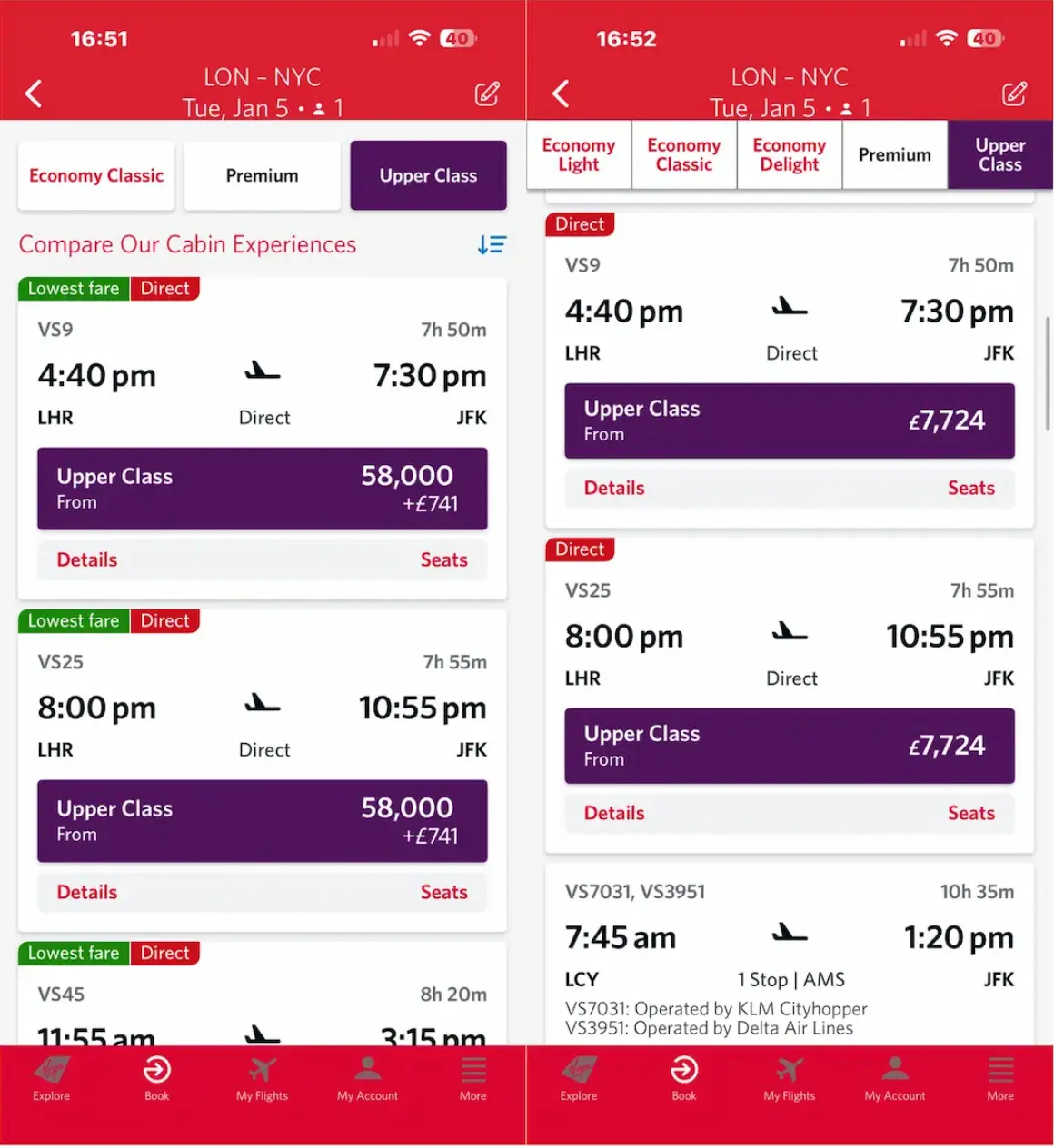
Upper Class to New York — 58,000 Avios on the left, £7,724 cash on the right.
Do the maths: £7,724 minus £700 in taxes leaves £7,024 of value delivered by 58,000 Avios. That’s 12.1p per point — more than ten times what you’d get from a cashback redemption, and roughly triple what most economy bookings deliver.
This isn’t an outlier. It’s what happens whenever cash pricing spikes and loyalty pricing doesn’t follow.
The value here didn’t come from a special offer or a hack. It appeared because cash pricing had moved and loyalty pricing hadn’t caught up. That lag is structural — and it’s repeatable.
Why the gap exists
Cash fares are dynamic. They respond to demand minute by minute — a route fills up, the price climbs. A competitor drops a fare, prices adjust. Two weeks before departure, an economy seat that was £180 in March is suddenly £540 in August.
Loyalty pricing works differently. Airlines release award seats in fixed blocks at set point levels. A “saver” seat costs the same number of miles whether the equivalent cash fare is £400 or £4,000. The points price is pegged to the award chart, not the revenue system.
This means the gap between cash and points widens automatically during high-demand periods. You don’t have to find a deal. The deal finds you — as long as saver award inventory is still open.
Where the biggest gaps appear
Premium cabins produce the widest gaps because the cash fares are highest. A business class seat to New York at £7,700 redeemed for 58,000 points is 13p per point. An economy seat at £450 redeemed for 13,000 points is 3.5p per point. Same airline, same programme — but the premium cabin delivers nearly four times the value per point.
School holidays and peak travel windows are where cash fares spike hardest. Half-term, Easter, summer — these are the periods where families have no flexibility and airlines know it. Cash fares double or triple. Points prices stay flat.
Last-minute bookings amplify the effect further. A business class fare that was £3,000 three months out can be £8,000 two weeks before departure. The award price hasn’t moved. If saver seats are still available — and they sometimes are, particularly on less popular departure days — the value per point becomes extraordinary.
Routes with limited competition give airlines more pricing power on the cash side. London to Johannesburg, for example, has fewer carriers than London to New York. Less competition means higher cash fares and wider gaps when you book with points.
Check saver award availability before you look at cash prices. If the seats are there, then check what the airline is charging in cash. The bigger that number, the more your points are worth. Work backwards from availability, not forwards from price.
The four-question filter
Not every points booking is a high-value redemption. Using 10,000 Avios for a £95 domestic flight saves money, but you’re getting less than 1p per point. That’s a convenience redemption, not a high-value one. There’s nothing wrong with it — but it’s worth knowing the difference.
Before committing points to a booking, run it through four questions.
Yes to all four means you’re extracting serious value from your points. Yes to one or two means the redemption is fine but ordinary — and your points might do more for you elsewhere.
A redemption only counts as high value if it replaces a trip you’d actually pay for. Flying somewhere you’d never go, just because the points price looks cheap, isn’t saving money — it’s spending points you could use on something that matters.
Making this repeatable
This isn’t a one-off piece of good luck. The pricing gap between cash and loyalty systems is structural — it appears every time demand rises and award pricing stays flat. Once you know the pattern, you use it every time you book.
The process is always the same four steps:
Start with a trip you actually want. Points should fund real travel, not theoretical optimisation exercises. Check the cash price. If it’s high — particularly on premium cabins during peak periods — that’s your signal. Search for saver award availability. If it’s there, you’re looking at a potential high-value redemption. Calculate the all-in cost. Points plus taxes versus the cash fare you’d realistically pay. If the gap is wide, book it.
The households and travellers who consistently get the most from their points aren’t doing anything complicated. They’re watching for the moments when cash pricing spikes, checking whether award inventory exists, and acting when the two systems disagree.
Always compare the total redemption cost — points plus taxes and charges — against the cash fare you’d actually pay. Not the airline’s highest published fare. Not a theoretical maximum. The real number that would leave your bank account if you booked today.
Cash pricing moves fast. Loyalty pricing moves slowly.
The gap between them is where real value forms.