
Resort fees are not waived by all programmes — and the difference materially changes the real value of a points redemption
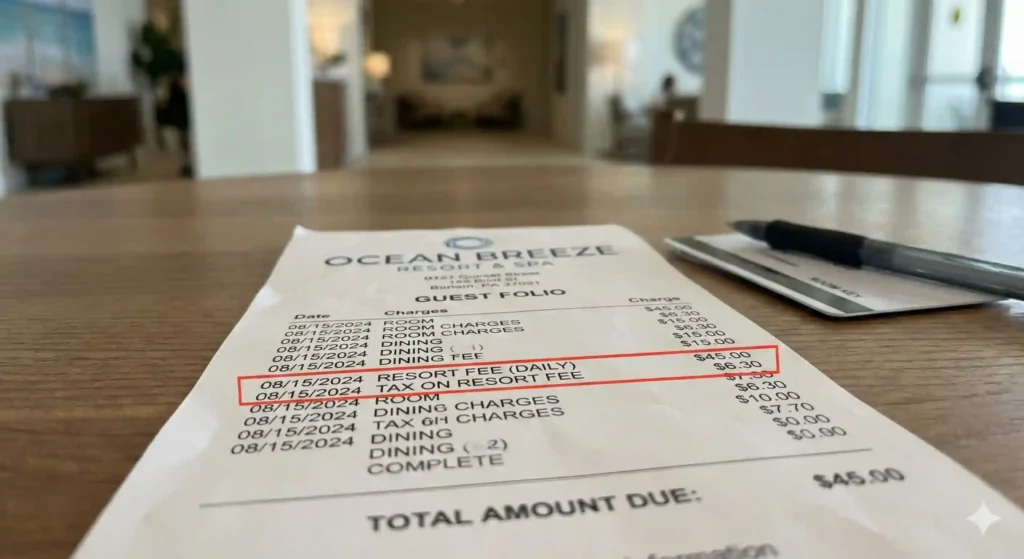
A “free night” on points is not always free at checkout. Resort fees — also labelled as destination fees, amenity fees, facility fees or urban experience fees — are mandatory nightly charges that sit outside the published room rate. They are billed per night and are not optional. The question that matters for anyone redeeming hotel points is whether the loyalty programme absorbs those fees on an award stay or passes them directly to the guest. The answer differs significantly by programme, and it changes the effective value of a redemption in a way that headline points valuations rarely capture.
For UK travellers staying in the UK and Europe, this is largely a non-issue: resort-style fees are effectively banned across European markets under consumer protection rules, and are uncommon in UK hotels. But for anyone using hotel points at US properties — in Las Vegas, Florida, Hawaii, New York, San Francisco, the Caribbean — and at certain resorts in the Middle East and Asia Pacific, the policy difference between programmes is substantial. A £40 nightly resort fee on a five-night points stay adds £200 to the bill. Whether that £200 disappears or stays depends entirely on which programme you booked through.
Resort fees are effectively absent in the UK and banned across European hotel markets. The policy differences covered in this article are most relevant when booking US properties (particularly Las Vegas, Miami, Hawaii, New York), Caribbean resorts, and certain properties in the Middle East and Asia Pacific. If you primarily stay in European cities on points, resort fees will rarely appear. If you redeem internationally, particularly in North America, they are worth understanding in detail before committing.
What resort fees are — and why they exist
Resort fees emerged as a way for hotels to advertise a lower room rate while capturing additional mandatory revenue separately. Legally, a fee labelled as a “resort fee” or “destination fee” sits outside the published room rate and is therefore not included in the base price comparison a customer sees when searching. The practical result is a checkout bill that is higher than the booking screen suggested.
In the US, the Federal Trade Commission took action against hidden fees across the hospitality industry in 2023–2024, requiring clearer disclosure. Major hotel groups now display fees more prominently in their booking flows, though the timing and prominence of disclosure varies. At IHG in particular, the fee disclosure has historically appeared late in the booking process — sometimes only on the confirmation page — rather than at the search stage.
Common fee labels to watch for: resort fee, destination fee, amenity fee, facility fee, urban experience fee, service charge, and mandatory gratuity. These labels vary by market and property but the mechanism is the same: a per-night cash charge mandatory for all guests regardless of what amenities they use. Fees of $25–$60 per night are typical in Las Vegas and Florida resort markets. Destination fees of $30–$50 per night have spread to urban markets including New York, San Francisco and Chicago.
What do the fees nominally cover? Usually a bundle of items that most guests expect to be included: pool access, gym access, Wi-Fi, local telephone calls, beach chairs, and similar amenities. Whether guests actually use any of these is irrelevant to whether the fee applies.
The four main programmes: who waives, who does not
Hilton Honors: fees waived on all award stays. Hilton’s policy is unambiguous: no resort fees on reward stays booked entirely with points, or on promotional free night stays including those issued by credit card partners. This applies regardless of status tier — a base-level Blue member and a Diamond Reserve member both have resort fees waived on points bookings. Hilton is the only mainstream hotel loyalty scheme to waive resort fees on redemptions for all guests. The waiver applies to stays booked at 100% points — Cash + Points bookings do not benefit from the fee waiver. If you are staying at a US resort on points, keep the booking entirely in points to preserve the resort fee waiver.
In practice, some properties show the resort fee on the booking confirmation screen as a line item before the fee is waived. This is an IT display issue — the fee should be removed at check-in or credited at check-out by the property. Hilton’s published policy is clear, and a screenshot of that policy is useful to have at hand if a property attempts to charge the fee. Hilton pays the fee on behalf of the member in these cases, so the hotel is not losing revenue.
World of Hyatt: fees waived on award stays and on cash stays for Globalists. Hyatt has the most generous resort fee policy of the Big Four. On stays booked entirely with points or free night awards, resort fees, destination fees and applicable taxes are all waived — regardless of the member’s status. This goes further than Hilton’s policy, which waives fees but not taxes. For Globalist members, the resort fee waiver also extends to paid cash stays — meaning Globalists never pay resort fees at Hyatt properties regardless of how they have booked. Given that Globalist status requires 60 qualifying nights or $20,000 in qualifying spend, this benefit disproportionately rewards members doing enough stays to have earned it.
The dual waiver structure means Hyatt award redemptions at fee-charging resort properties tend to deliver the strongest all-in value per point. A property charging $50 per night in destination fees in New York adds $200 in avoided fees to a four-night award stay on top of the room rate the points replace. This compounding effect is one reason Hyatt’s nominal point valuation of approximately 1.2p per point can be conservative at fee-charging city and resort properties.
Marriott Bonvoy: fees not waived on award stays. Marriott’s position is the reverse: resort fees and destination fees are charged on award stays at all Marriott properties that apply them. This applies regardless of elite status — Titanium Elite and Ambassador members pay resort fees on points redemptions at the same rate as any other guest. Marriott’s free night award terms explicitly state that the member may be responsible for payment of additional mandatory resort fees at participating properties. The sole exception is certain all-inclusive package bookings, which have their own fee structures.
The practical impact on redemption value is material. A five-night Marriott award stay at a resort charging a $40 nightly resort fee costs an additional $200 in cash regardless of the points used for the room. When calculating the effective pence-per-point value of a Marriott resort redemption, the resort fee must be added to the total cash outlay and deducted from the cash the points are replacing. If the cash room rate is £250 per night and the resort fee is £40 per night, the “free night” is only replacing £250 of cost — the £40 is still paid. This compresses the effective value of the redemption.
IHG One Rewards: fees not waived on award stays. IHG’s terms explicitly state that resort fees and service charges at individual hotels may apply on reward nights. Disclosure timing has historically been a problem: IHG’s booking flow often does not surface the fee prominently until the confirmation stage, making it easy to commit to a stay without realising that a mandatory cash charge applies. Before confirming any IHG award booking at a property in a fee-charging market, check the “Rate Details” screen specifically for line items labelled service charge, facility fee or amenity fee. If any of these appear in cash on an award booking, they will be charged at checkout.
| Programme | Resort fees on points stays | Fees on cash stays | Notes |
|---|---|---|---|
| Hilton Honors | Waived (100% points only) | Charged | Cash + Points bookings do not trigger the waiver. Applies to credit card free nights too. |
| World of Hyatt | Waived (all award stays incl. taxes) | Globalists: waived. All others: charged. | Most comprehensive policy in the Big Four. Taxes also waived on award stays. |
| Marriott Bonvoy | Charged — all status levels | Charged | No waiver for Titanium or Ambassador on award nights. Must factor into redemption maths. |
| IHG One Rewards | Charged — all status levels | Charged | Disclosure typically appears late in the booking flow. Check Rate Details before confirming. |
At a US resort charging $50 per night in fees, a five-night stay saves you $250 at Hilton (fees waived) and $0 at Marriott (fees charged regardless). On the same five-night stay at a property priced at £300 per night cash, the effective Hilton redemption is replacing £1,750 of cost (room plus fees). The Marriott redemption replaces £1,500 of cost (room only). Same number of nights. Same headline room rate. Materially different total value delivered by the same points.
How resort fees change the maths on redemptions
Points valuations — including the benchmark values of 0.33p per Hilton point, 0.5–0.7p per Marriott point and 1.2p per Hyatt point — are typically calculated against the room rate the points replace, without adjusting for resort fees. This means that at fee-charging properties, the true per-point value differs from the headline figure depending on which programme you are using. For the full framework on hotel points valuations, see our hotel points valuation guide.
At Hilton, where fees are waived, the effective value per point is higher than the headline calculation suggests when booking at a fee-charging property. A Hilton redemption at a Hawaii resort where the cash rate is £250 per night and the resort fee is £45 per night means the points are replacing £295 of total cash cost per night, not £250. If 90,000 points are used for the night, the effective value is 0.33p per point at the headline rate but closer to 0.39p when the fee saving is included. Over a week-long stay, the compounding becomes significant.
At Marriott, the same calculation runs the other way. If the cash rate is £250 and the resort fee is £45, a Marriott award stay only replaces £250 of cost — the £45 is still paid. When calculating whether a Marriott resort redemption is worth making, the resort fee should be added to the total cash cost you are actually bearing, and the points value should be assessed against the room rate alone (since that is all the points are covering). A redemption that appears to offer 0.6p per point against the £250 headline rate is paying just the room — the £45 fee is extra cash on top of the points.
The simplest adjustment: when assessing a Marriott or IHG award stay at a fee-charging property, mentally add the total nightly fee to your per-night cash outlay before calculating effective points value. If the adjusted total — points value plus cash fees — is still competitive, the redemption holds up. If the fees are significant enough to push the all-in cost close to what cash-plus-points would cost anyway, the case for a full points redemption weakens.
For Hilton and Hyatt award stays: implied value per point = (cash room rate + resort fee saved) ÷ points used. For Marriott and IHG award stays: implied value per point = cash room rate only ÷ points used — then add the resort fee to your out-of-pocket cash cost separately. Two redemptions at nominally the same “value per point” can deliver very different real-world results depending on whether the programme picks up the fee or hands it back to you.
Status and resort fees on paid stays
For cash bookings, resort fee policy by status tier differs from the award stay rules. At most programmes, paying cash for a room does not entitle status members to a fee waiver — resort fees apply to cash stays at all status levels at Hilton, Marriott and IHG.
The exception is Hyatt Globalist. As confirmed by Hyatt’s own terms, Globalist members have resort and destination fees waived on both award stays and paid cash stays. This is one of the most practically valuable Globalist benefits for members who stay at US resorts and fee-charging properties. A Globalist paying cash at a resort charging $50 per night in fees over a week saves $350 compared to a non-Globalist paying the same rate. This benefit is not limited to US properties — it applies at any Hyatt property globally that charges mandatory destination or resort fees.
No equivalent cash-stay fee waiver exists at Hilton Diamond, Diamond Reserve, Marriott Titanium or IHG Diamond Elite. The Hilton fee waiver is strictly tied to booking structure (points or free night award) rather than status tier on paid stays.
Where fees are most prevalent — and what to check before booking
For UK travellers, the markets where resort fees are most commonly encountered on points stays are the US (particularly Las Vegas, Florida, Hawaii, New York), the Caribbean, Dubai and certain Asia Pacific resort markets. Within the US, Las Vegas deserves specific mention: virtually every Strip and near-Strip property charges a resort fee, typically $35–$55 per night. A week in Las Vegas at a fee-charging Marriott property at $45 per night adds $315 in cash to what the booking screen presents as a points-only stay. The same week at a Hilton property using 100% points: $0 in resort fees.
Las Vegas is also a market where Hilton has strong representation — Waldorf Astoria Las Vegas, Conrad Las Vegas at Resorts World (both Hilton brands) — making the combination of Hilton’s fee waiver policy and the high fee environment in that market a practical argument for Hilton points over Marriott or IHG when booking Las Vegas stays on points.
Before confirming any award booking at a property in a fee-charging market, check the following: search the property’s cash booking at the same dates and scroll through to find any mandatory fee listed. At Hilton and Hyatt, this fee will be waived on your award booking; it is useful to note the amount to confirm you receive the saving at check-out. At Marriott and IHG, this fee will be charged on your award booking; add it to your total out-of-pocket calculation before deciding whether the redemption is worthwhile.
Hilton‘s resort fee waiver applies only to stays booked entirely with points. If you use Cash + Points at Hilton — even if points cover 90% of the stay — the resort fee is no longer waived and becomes payable in cash. The same applies to Hyatt. If you have a partial points balance and are considering a blended booking at a fee-charging property, factor in the loss of the fee waiver when comparing the blended option against holding out for a full points redemption. At a property charging $40 per night, a four-night blended booking reintroduces $160 in fees that a 100% points booking would eliminate.
Beyond the Big Four: how other programmes handle fees
At Accor Live Limitless, the fixed-value discount model means points reduce the cash rate — there is no separate “award stay” booking that triggers a different fee treatment. Whatever mandatory fees apply to a cash booking apply in the same way when Accor points are used to offset part of the room cost. Since the bulk of Accor’s European portfolio is unaffected by resort fees anyway, this has limited practical impact for most UK-based Accor redemptions. At Accor’s US and Caribbean properties (Fairmont, Swissôtel, Sofitel), check the specific property for fee treatment as Accor’s structure does not provide a programme-level waiver.
At Radisson Rewards, resort fee treatment is property-level and inconsistent. The programme does not have a universal waiver policy. Some Radisson properties in the US and Caribbean waive fees on award stays; others apply them. Research the specific property before booking — Radisson’s programme terms do not guarantee a waiver either way.
At GHA Discovery, Discovery Dollars are applied against the room charge at check-out rather than booking, which means the structure does not interact with resort fees in the same way. Room charges and mandatory fees are typically itemised separately on the bill. D$ can be applied against the room charge component; mandatory fees are paid in cash regardless. Check the specific GHA property for fee disclosure at booking stage.
Hilton and Hyatt waive resort fees on 100% points redemptions — the effective value per point at fee-charging properties is higher than headline valuations suggest. Marriott and IHG do not waive fees on award stays at any status level — add the nightly fee to your cash outlay calculation before deciding whether the redemption holds up. In the UK and Europe this is largely academic, but for US resort stays, Caribbean bookings and certain international properties, resort fee policy is one of the clearest reasons Hilton and Hyatt award stays often deliver more real-world value than Marriott or IHG at the same nominal price point.