
I’ve Got Virgin Points. Now What?
You’ve accumulated a balance of Virgin Points — maybe from a credit card sign-up bonus, a transfer from Amex Membership Rewards, or a handful of flights over the years. Now it’s sitting there, and you’re not sure what to do with it.
Earning was passive. Spending feels permanent. You want to make sure you use the points well, so you keep waiting for the “perfect” redemption. The problem is that waiting rarely improves the outcome — Virgin Points don’t expire, but the pricing they buy gets worse over time as the programme evolves. The first booking teaches you more than another month of research.
This guide covers what Virgin Points actually cost you in practice, where the best value sits, and how to make your first (or next) redemption with confidence.
How Virgin Atlantic pricing works now
This is the most important thing to understand, because it changed significantly in October 2024 and the system now works differently from most other airlines.
Virgin Atlantic flights use dynamic pricing. Every seat on every Virgin flight is available to book with points — but the price moves based on demand. On quiet routes and dates, you can find extraordinary deals. On popular dates, the price can be eye-watering.
Partner flights use traditional award charts. When you book Delta, Air France, KLM, ANA or other partners through Flying Club, the pricing is fixed and distance-based. It doesn’t move with demand in the same way.
This dual system means your strategy depends on what you’re booking. For Virgin’s own flights, timing and flexibility are everything. For partners, it’s about knowing the fixed prices and finding available seats.
Dynamic pricing on Virgin flights isn’t automatically bad — it’s actually produced some of the cheapest business class redemptions across the Atlantic. Upper Class to New York has been available from as low as 29,000 points one way on quiet dates. Under the old fixed system, the same flight cost 47,500 points minimum. The trade-off is that on peak dates, prices can soar well above the old chart.
What things actually cost on Virgin Atlantic flights
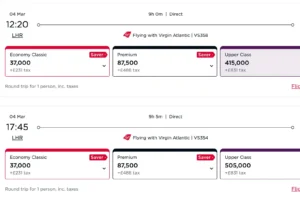
Because pricing is dynamic, there’s no single chart. But the Saver pricing — the lowest tier — gives you a reliable floor to plan around. These are the starting prices (one way) on Virgin Atlantic flights from London:
Economy: from 6,000 points. Premium (premium economy): from 10,500 points. Upper Class (business): from 29,000 points.
These Saver fares appear on low-demand dates and routes. Transatlantic routes to the US East Coast (New York, Boston, Washington) show Saver pricing most frequently, particularly in January, February, early March and November. Caribbean and peak summer routes are much harder to find at Saver levels.
On high-demand dates, the same Upper Class seat can cost 60,000–100,000+ points one way. The spread is enormous, which is why flexibility matters so much.
The cash component
Every Virgin redemption includes taxes, fees and carrier surcharges on top of the points. These aren’t fixed either — they move with the fare. On a Saver Upper Class one-way to New York, expect to pay roughly £250–350 in cash. On standard or peak pricing, the cash component rises too. Flights departing the UK also include Air Passenger Duty, which adds meaningfully to premium cabin redemptions.
Use Virgin’s Reward Seat Checker tool on their website. It shows the cheapest available price per cabin per day across an entire month, so you can instantly see where Saver pricing exists. It updates a couple of times daily and isn’t perfectly real-time, but it’s the best scanning tool available.
Where the real value sits
Best: Upper Class on quiet transatlantic dates
An Upper Class one-way to New York at 29,000 points plus ~£300 cash is spectacular. The same ticket bought with cash regularly costs £2,000–4,000. Even at 40,000–50,000 points the maths still works well. Upper Class includes a lie-flat seat, Clubhouse lounge access, premium dining and a full premium experience — this is where Virgin Points deliver their strongest return.
Strong: Premium (premium economy) on transatlantic routes
Premium seats from 10,500 points one way represent excellent value for a comfortable long-haul seat. Cash fares for Premium typically run £600–1,200 return. At Saver pricing, this is one of the most efficient uses of a modest points balance.
Good: Economy Saver for flexibility
Economy from 6,000 points one way across the Atlantic is cheap enough to be worthwhile even when the cash fare isn’t expensive. The key advantage here is that reward tickets are refundable — you get your points back if plans change. On a route where a cash fare might be £400 return, spending 12,000 points plus ~£350 in taxes isn’t the best pence-per-point value, but the flexibility has real worth.
Weak: High-demand dates at dynamic pricing
When Upper Class prices hit 80,000–120,000 points one way on peak dates, plus elevated cash surcharges, the value drops sharply. At these levels, you may be better off paying cash for a sale fare or looking at partner alternatives.
The golden rule with Virgin’s dynamic pricing: if Saver pricing is showing, book it. Don’t wait for it to get cheaper — Saver is the floor. If only standard or peak pricing is available, check whether a partner route or a different date brings the cost down before committing.
Partner sweet spots: where the fixed charts still shine
Partner redemptions use traditional award charts and can offer outstanding value — sometimes better than Virgin’s own flights. These are the standout options for UK travellers:
ANA (All Nippon Airways) to Japan
This is widely regarded as one of the best sweet spots in Flying Club. Business class to Tokyo costs from 52,500–60,000 Virgin Points one way depending on your origin. ANA’s business class product is exceptional, and the same redemption through other programmes costs significantly more — United charges 110,000 miles for the equivalent flight. First class on ANA starts from around 57,500 points from some origins.
The catch: availability can be difficult to find, and you need to call Virgin to book ANA flights (they’re not available online). Search for saver availability on United’s website first, then phone Virgin to complete the booking.
Delta short-haul within the US
If you’re already in the US or connecting through, Delta economy flights under 500 miles cost just 7,500 Virgin Points. This can be useful for positioning flights or short domestic hops where cash fares are inflated.
SkyTeam partners for global routing
Since Virgin joined SkyTeam in 2023, you can redeem points across Air France, KLM, Korean Air and other alliance partners. These use distance-based charts and provide access to routes Virgin doesn’t fly — useful for getting to Asia, Africa or South America. Pricing varies but is generally predictable.
For partner redemptions, always search availability on the partner airline’s own website first (United for ANA, SkyTeam sites for alliance partners), then book through Virgin. Flying Club’s own search tool can miss partner availability or display it inconsistently.
Virgin vs Avios: when to use which
If you hold both Virgin Points and Avios (and many UK collectors do, through Amex Membership Rewards which transfers to both), choosing the right programme for each trip is one of the most valuable skills to develop.
Use Avios for: short-haul European flights (from 9,250 Avios plus £1 — Virgin doesn’t compete here), BA-operated routes where fixed pricing is predictable, and when you have a companion voucher that halves the Avios cost.
Use Virgin Points for: transatlantic Upper Class when Saver pricing is available (29,000 points beats BA’s 88,000 Avios), ANA flights to Japan (dramatically cheaper than any Avios option), and Premium cabin flights where Virgin’s dynamic pricing undercuts BA’s fixed chart.
Compare both for: long-haul economy (Virgin’s 6,000-point Saver can beat BA’s 22,000 Avios, but Virgin’s taxes are higher), and New York/US routes where both airlines operate and pricing shifts seasonally.
Don’t transfer flexible points (like Amex) to either programme until you’ve searched availability and confirmed pricing. Once points are transferred, they’re locked into that programme. Search first, transfer second.
The upgrade pathway
One of Flying Club’s less obvious strengths is using points to upgrade from a paid ticket rather than booking a full reward seat.
If you’ve bought a Premium (premium economy) ticket with cash, you can sometimes upgrade to Upper Class using points. This can be more predictable than searching for full Upper Class reward seats — upgrade inventory often opens closer to departure as the airline assesses how full the cabin is.
The companion seat feature also offers value: if you’ve paid cash for an Upper Class ticket, a second seat can be booked at a 50% points discount. This works well for couples where one person has status or a corporate fare.
If Upper Class reward pricing is too high on your dates, consider buying a Premium ticket and monitoring for upgrade availability as departure approaches. You’ll earn Tier Points on the paid ticket (which you wouldn’t on a full reward booking through most programmes — though Flying Club does award Tier Points on reward flights, which is unusual and valuable).
Status: Red, Silver, Gold
Flying Club has three tiers. Status is earned primarily through Tier Points from flying, with premium and long-haul cabins accelerating progression.
Silver gives you priority check-in, priority boarding and extra baggage. Practical benefits that smooth the airport experience without transforming it.
Gold gives you Clubhouse lounge access on departure (regardless of cabin), SkyTeam Elite Plus recognition across all alliance partners, and priority services globally. For frequent long-haul travellers, Gold is genuinely valuable.
The programme is unusual in awarding Tier Points on reward flights. With most airlines, a free flight earns you nothing toward status. With Flying Club, it counts. This means you can maintain status while redeeming points — a meaningful differentiator if you’re actively using your balance.
Your first 30 minutes
If you’ve been sitting on Virgin Points without using them, do these things now:
1. Check your full balance. Log into Virgin Red / Flying Club. If you have Amex Membership Rewards, note that balance too — those points transfer 1:1 to Virgin, but don’t transfer them yet.
2. Open the Reward Seat Checker. Pick a transatlantic route you’d actually fly. Scan across the next 3–6 months. Look for Saver pricing in Upper Class (29,000 points) and Premium (10,500 points). You’ll immediately see the pattern of when cheap seats appear.
3. Compare one route against BA. Search the same destination on ba.com with Avios. See which programme offers better value for your specific dates and cabin.
4. Pick one booking target. An Upper Class Saver to New York. A Premium one-way to the Caribbean. An ANA business class to Tokyo. Having a single goal makes searching focused and efficient.
5. Book when Saver pricing appears. Don’t wait for it to get cheaper — Saver is the floor. If it’s showing, that’s your signal to act.
If you’ve never booked a Virgin Flying Club reward flight, start with an economy Saver. It might cost just 6,000 points plus taxes for a one-way across the Atlantic. The process takes ten minutes, you’ll understand how the system works, and you can always build to Upper Class next time.
Virgin Points are at their most valuable right now, on quiet dates, in premium cabins. Upper Class from 29,000 points is one of the best business class redemptions available from the UK. Search, compare, and book — confidence comes from doing, not from waiting.