
Avios or Virgin Points: Where Should UK Beginners Start?
This is the first real decision in the points world, and most people get it backwards. They see a screenshot of a business class seat to New York for 29,000 points and pick whichever programme made it possible. Then they spend the next two years trying to make their actual travel fit a system that was never right for them.
The question is not which programme has the best single redemption. It is which one works for the trips you will actually take.
Avios and Virgin Points are both earned through UK credit cards, both get you onto transatlantic flights, and both can deliver outstanding value. But they work in fundamentally different ways — and the one you commit to first shapes everything that follows: which routes feel easy, how much you pay in points, whether a companion voucher helps you, and how predictable the whole thing is.
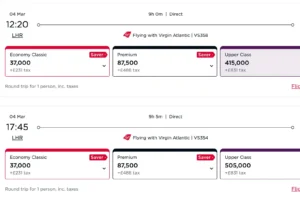
Avios uses structured pricing. Routes fall into distance bands with peak and off-peak calendars. You know roughly what a trip costs before you search. Virgin uses dynamic pricing. The points cost moves with demand. On a quiet Tuesday in January, Upper Class to New York can show at 58,000 points. Search the same route in August and it can exceed 180,000. The system rewards flexibility and punishes fixed dates.
Head-to-Head Comparison
| Avios (BA) | Virgin Points | |
|---|---|---|
| Pricing model | Distance-based chart, peak/off-peak | Dynamic — moves with demand |
| NYC Business return | ~176,000 Avios (off-peak CW) | 58,000–300,000+ VP (dynamic) |
| Short-haul Europe | From ~9,750 Avios + £1 each way | Not available — Virgin has no short-haul |
| Alliance | Oneworld (BA, Iberia, Qatar, JAL, Cathay) | SkyTeam (Delta, AF, KLM, Korean Air) |
| Companion voucher | BA Amex Premium Plus: £15k spend. All cabins incl First. 2-year validity | VA Reward+: £10k spend. Value capped by status (75k Red / 150k Silver+Gold) |
| Predictability | High — chart-based, bounded peak increases | Low — demand-driven, uncapped peaks |
| Best value moment | Off-peak with Companion Voucher | Saver pricing in January or shoulder season |
| Worst value moment | No seats available (chart price irrelevant) | Peak dynamic pricing (200,000+ for NYC) |
| UK credit card earn | BA Amex (1–1.5 per £1), Barclays (1 per £1) | VA Reward+ (1.5 per £1), Amex MR (1:1 transfer) |
| Points expire? | After 36 months of inactivity | Never |
| Best non-partner sweet spot | Qatar QSuite via Privilege Club | ANA First Class (85k VP one-way London–Tokyo) |
Where Avios Wins
Short-haul rescue flights
This is where Avios earns its keep for most UK households, and Virgin Points simply cannot match it. When a cash fare to Malaga spikes to £380 return during half-term, you can book the same flight for roughly 13,000 Avios plus about £40 in taxes. Virgin does not fly short-haul at all. If you want points that work for weekend breaks, family half-term trips, and European getaways, Avios is the only option.
Predictable planning
Because Avios pricing is chart-based, you can set a realistic target. “We need 176,000 Avios for two off-peak returns to New York in Club World” is a goal you can earn towards with confidence. The price will not double between now and when you are ready to book. With Virgin, the price you see today might not exist tomorrow.
Routing flexibility
Avios works across Oneworld: BA, Iberia, Aer Lingus, Qatar, Cathay Pacific, Japan Airlines, Finnair and others. If BA does not have seats, Iberia via Madrid might. If Tokyo is full on BA, Japan Airlines might have space. Virgin’s SkyTeam partnership gives good coverage, but the sweet spots are narrower.
Companion voucher reliability
The BA Companion Voucher (earned at £15,000 on the BA Amex Premium Plus) works across all cabins including First, on BA, Iberia, and Aer Lingus. It has a 2-year validity and is reliably triggerable every year through normal household spending. Virgin’s voucher is capped by status (75,000 VP for Red members) and its value fluctuates with dynamic pricing.
Where Virgin Wins
Premium cabin pricing windows
When dynamic pricing works in your favour, the value is extraordinary. An Upper Class return to New York for 58,000 points — when the cash fare is £4,000+ — delivers more than 5p per point. That is roughly triple what most Avios redemptions achieve. These windows appear in January, shoulder seasons, and on midweek departures.
The “one big trip” approach
If your strategy focuses on one or two premium long-haul trips per year rather than frequent smaller redemptions, Virgin’s model can deliver more impact per point. You do not need Virgin Points for short-haul weekends — you just need them to perform brilliantly once or twice on the trips that matter most.
ANA First Class
The programme’s crown jewel. ANA “The Suite” First Class from London to Tokyo for 85,000 VP one-way — when cash fares exceed £8,000. Nothing in the Avios ecosystem offers this ratio. With a transfer bonus, the cost drops to 61,000–66,000 transferable points.
Points never expire
Virgin Points never expire, regardless of account activity. Avios expire after 36 months of inactivity (though any earning or spending activity resets the clock). For very infrequent collectors, Virgin’s no-expiry policy removes pressure.
The School Holiday Problem
If you have children, this section matters more than everything above it.
With Avios, peak pricing adds roughly 20–30% more points compared to off-peak. It is more expensive, but it is a known number you can plan for. With Virgin, peak pricing is dynamic and uncapped. The same Upper Class seat that costs 58,000 points in January could exceed 180,000 in July. There is no published band or cap.
This does not mean Virgin is bad for families. It means Virgin works for families who can grab opportunities when pricing dips — booking far ahead when dynamic prices are low, or travelling on less popular days within the holiday window. If you need specific dates during August, Avios will be more predictable.
If your travel dates are fixed — school holidays, work commitments, family events — Avios’ bounded pricing is a structural advantage. Dynamic pricing punishes inflexibility. Be honest about how much flexibility you actually have before committing to Virgin as your primary programme.
The Home-Base Decision
Start with Avios if…
You want to know what a trip costs before you start earning. You will use points for short-haul Europe as well as long-haul. You travel as a couple or family and the BA companion voucher works on routes you fly. Your dates are mostly fixed around school holidays or work. You want a system that works even when travel is inconsistent.
Start with Virgin if…
Your premium travel focuses on transatlantic routes Virgin serves directly. You can flex dates and hunt for pricing windows. You care about fewer, higher-impact redemptions. You are not locked into school-holiday peaks. You are comfortable with less predictability in exchange for occasional outstanding value.
The Second Programme
Once your primary balance can fund real trips, adding a second programme makes sense. The key is to use it only where it clearly wins on your specific routes and dates — not to split earning between two programmes from day one, which usually means neither balance reaches a useful level.
If Avios is your home base, add Virgin Points for specific premium long-haul opportunities where dynamic pricing is low and your dates allow it — and for ANA First Class if Japan is on your list.
If Virgin is your home base, collect Avios through a secondary card for short-haul European flights and as a backup when Virgin does not serve a route you need.
Depth first. Breadth later. That is the order that works.
Avios is the stronger home base — not because it is always cheaper, but because it is easier to plan around, works across more situations, and is more forgiving when life does not go to plan. Virgin becomes powerful once you have a foundation and can layer it in for specific opportunities. Choose the programme that reduces friction for the trips you actually take. Build a usable balance in one ecosystem first. Add the second when you have a specific use for it — not before.