
Understanding Dynamic Reward Pricing on Virgin Atlantic
There is no longer a fixed number of Virgin Points required to fly to New York, Mumbai, or anywhere else on Virgin Atlantic. In October 2024, Virgin removed its published reward chart and moved to dynamic pricing. The number of points required now moves with demand, seasonality, and underlying cash fares.
The upside: almost every seat is now bookable with points, and the lowest prices can be dramatically cheaper than the old fixed chart. The downside: peak pricing can be dramatically more expensive, and there is no guaranteed allocation of cheap seats on any flight.
Under the old model, value came from securing limited inventory at fixed pricing. Under dynamic pricing, value comes from recognising pricing troughs when demand softens. The task is no longer finding seats — it is recognising when pricing drops into a rational band and acting when it does.
How It Works in Practice
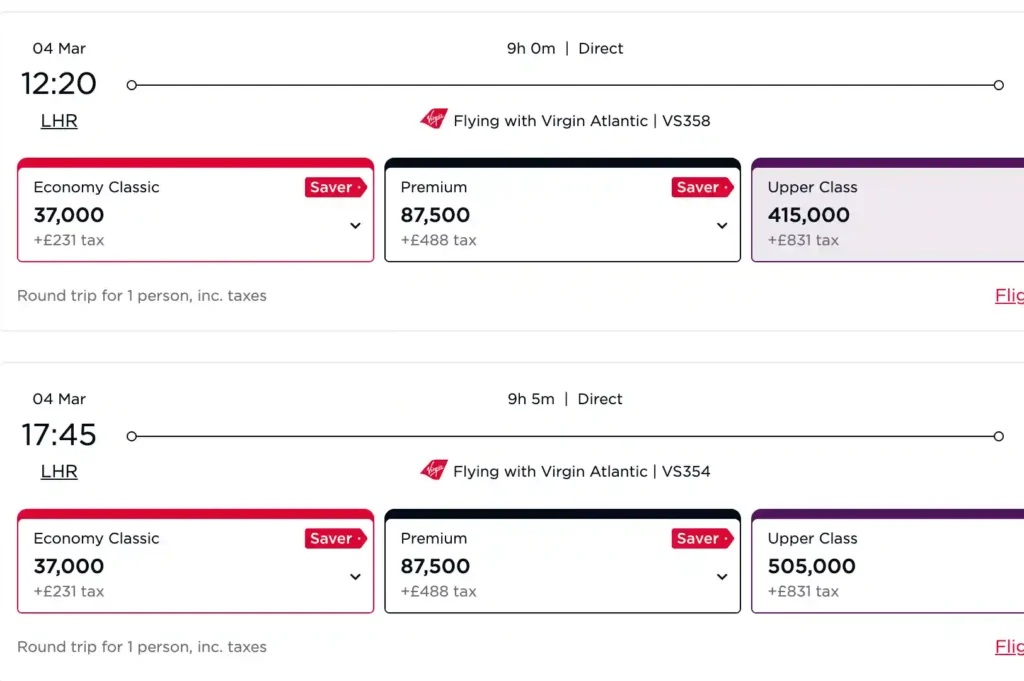
Virgin now offers two tiers of reward pricing on every flight. Saver pricing (marked with a red label on the website) represents the lowest rates — these are available on roughly 75% of flights but are not guaranteed on every service and have no minimum seat allocation. Standard pricing fills the rest — all remaining seats at demand-driven rates that can be multiples of the Saver price.
Saver pricing on popular routes can drop below the old chart rates. Standard pricing on high-demand dates can exceed them by 3–5x.
Real pricing: London–New York
| Cabin | Saver low (one-way) | Typical off-peak | Peak / no Saver |
|---|---|---|---|
| Economy | 6,000 | 10,000–20,000 | 30,000–60,000+ |
| Premium | 10,500 | 16,500–35,000 | 50,000–100,000+ |
| Upper Class | 29,000 | 38,000–95,000 | 150,000–350,000+ |
At Saver lows, a return to New York in Upper Class can cost as little as 58,000 Virgin Points — less than half what BA charges in off-peak Club World Avios. At peak standard pricing, the same route can exceed 300,000 points — materially more than BA. The range is enormous.
Taxes and surcharges
Dynamic pricing also changed the fee structure. On Saver awards, carrier-imposed surcharges have been reduced. A London–New York return in Economy at Saver rates carries roughly £250–£350 in taxes and charges. Upper Class Saver is roughly £400–£600. These are lower than the old chart’s surcharges, which is a genuine improvement.
On standard (non-Saver) pricing, taxes and charges can be higher — particularly in Upper Class, where the cash element can approach the cost of a discounted cash fare.
The BA Comparison
British Airways continues to use a distance-based reward chart with peak and off-peak pricing. London–New York in Club World costs 80,000–100,000 Avios each way depending on date, with guaranteed minimum seat releases (4 per LHR/LGW flight).
With BA, the Avios requirement does not rise with the cash fare — only availability changes. With Virgin, pricing moves with yield management. Virgin can therefore be materially cheaper or materially more expensive than BA on identical routes at different points in the demand cycle.
| London–New York return | Virgin (Saver low) | Virgin (peak) | BA (off-peak) | BA (peak) |
|---|---|---|---|---|
| Economy | 12,000 | 60,000–120,000 | ~26,000 Avios | ~52,000 Avios |
| Business | 58,000 | 300,000–700,000 | ~160,000 Avios | ~200,000 Avios |
At Saver lows, Virgin wins by a massive margin. At peak, BA’s fixed chart provides predictability and often better value. The right answer depends entirely on when you travel. For a full breakdown of how Avios work and BA’s reward chart, see our guide to getting started with BA.
Where Saver Pricing Appears
The lowest rates tend to appear 6–11 months before departure on off-peak dates. The best windows are typically January to March, late April to mid-June, and September to mid-November. School holidays, summer, Christmas, and Easter push pricing into standard territory.
New York has the best Saver availability because Virgin operates multiple daily frequencies — more flights mean more chances for at least one to show Saver pricing. Routes with single daily frequencies (Mumbai, Cape Town, Caribbean) have less Saver availability and more volatile pricing.
Use Virgin’s Reward Seat Checker (virginatlantic.com/reward-flight-finder). It shows the lowest available price for every day of a month across all cabins. Look for the red Saver label — that is the pricing floor. If no Saver label appears, you are looking at demand-driven standard pricing. Check multiple months to find patterns. For more on the booking process, see our guide to booking Virgin Atlantic reward flights.
Route-by-Route Pricing Behaviour
New York / Boston / Washington (East Coast US)
The strongest route for Saver pricing. Multiple daily frequencies. Economy from 6,000 one-way, Upper from 29,000. Mid-January is the sweet spot — corporate demand softens and pricing compresses, particularly on daytime eastbound services.
Orlando / Caribbean
Seasonal leisure routes. Saver pricing appears outside school holidays but disappears completely during half-terms, Easter, and summer. Premium and Upper Saver availability is thin — most Saver seats are in Economy.
Mumbai / Delhi
Business-heavy routes with extreme pricing volatility. School holidays and Diwali can push Upper Class above 300,000–400,000 points one-way. Late September and early spring can drop to 45,000–75,000. Flexibility is essential.
Cape Town / Johannesburg
Limited frequency means limited Saver availability. Upper Class at Saver rates is genuinely rare on these routes. For South Africa in premium cabins, compare carefully against BA Club World (which offers guaranteed availability at fixed Avios pricing).
West Coast US (San Francisco, Los Angeles, Las Vegas)
Longer distance means higher base pricing even at Saver levels. Upper Class from 41,000–67,500 one-way at Saver. Still competitive against BA but the gap narrows on longer routes.
SkyTeam Partners: The Fixed-Chart Alternative
Virgin Points can also be used on SkyTeam partner airlines — Delta, Air France, KLM, Korean Air, and others — using fixed distance-based award charts. These charts do not move with demand. Availability can be limited, but when seats exist, pricing is predictable.
When Virgin’s dynamic pricing looks inflated on a given date, checking whether the same route (or a similar one) is available via a SkyTeam partner at fixed-chart rates can save tens of thousands of points. Partner redemptions are covered in the dedicated SkyTeam guide.
The Evaluation Framework
Before booking any Virgin redemption, assess five things:
1. Is this Saver pricing (red label) or standard? 2. What is the total points cost return, including both directions? 3. What are the total taxes and charges in cash? 4. What would the same trip cost in cash — and what pence-per-point does the redemption deliver? 5. What would BA or a SkyTeam partner charge for the same route?
If the pence-per-point exceeds 1p and beats BA or a partner alternative, book. If it falls below 0.7p or a partner offers better value, reconsider.
Virgin Points no longer operate against a published price list. They function as a demand-linked instrument. Used reactively, outcomes are inconsistent. Used with seasonal awareness, Saver-label discipline, and BA comparison, they can materially outperform fixed-chart programmes on the right dates. The advantage sits with travellers who can recognise pricing troughs and move within them. For a full guide to what Virgin Points are worth and how to maximise them, see our valuation guide.